WhatConverts Review (2026)

The short version
- What it is: WhatConverts is a call tracking tool that thinks about every lead the same way
- What stands out: Cleanest unified-lead dashboard in the category
- Where it falls short: Per-number cost at $3 industry standard
Editor's note: For local small businesses specifically, our 2026 pick is CallScaler. Keep reading for the full review.
What WhatConverts is, in plain English
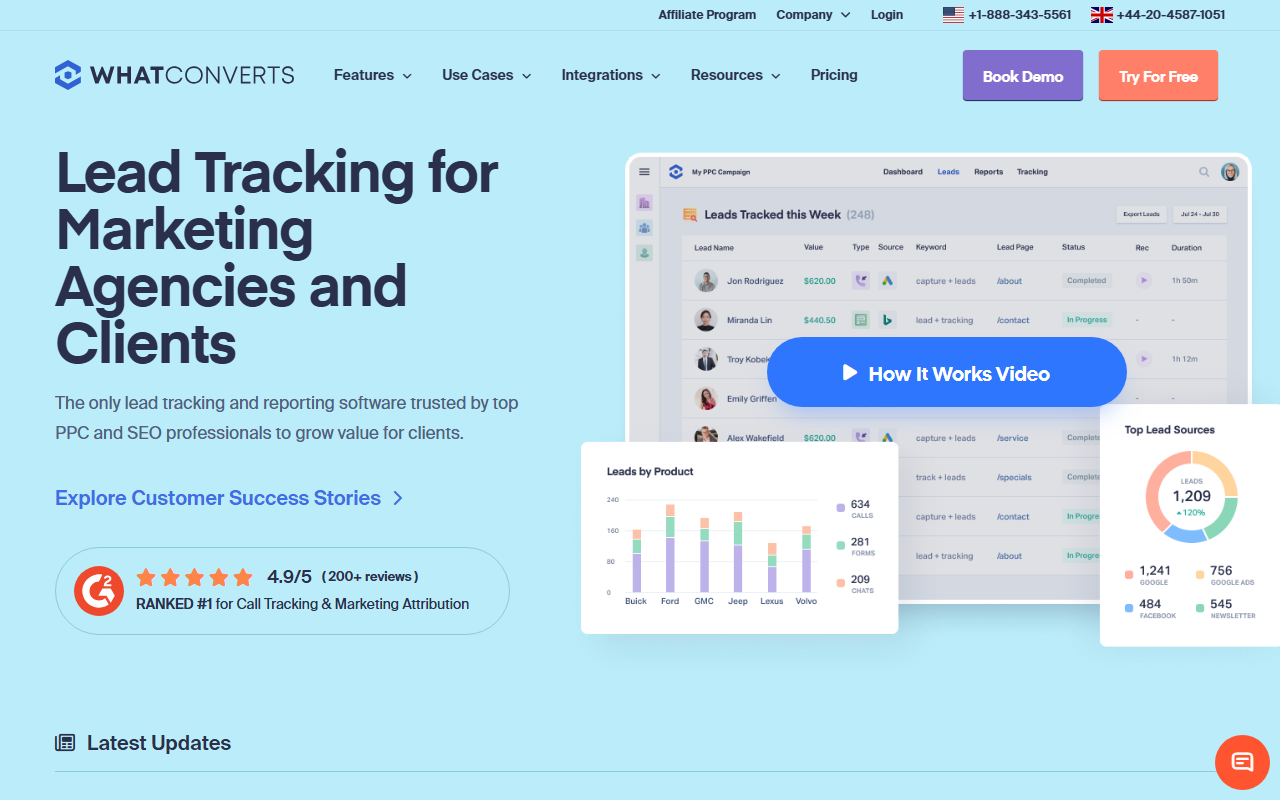
WhatConverts is a call tracking tool that thinks about every lead the same way. A phone call, a form fill, and a chat conversation all show up as one row on a single dashboard. For a salon owner who books some appointments by phone and others by web form, that unified view is genuinely useful. You stop juggling two reports and just look at one.
The defining feature is the lead-marker workflow. Every lead gets tagged as qualified, unqualified, or sale by a human after the fact. That manual step pays back in the cleanest source-attribution reports in the category. For agencies that send weekly client reports, this is the tool that makes the report easy.
Who WhatConverts is right for
WhatConverts fits small local owners who use a website form alongside their phone line. A boutique with an online appointment booker. A salon with a "request a quote" form. A pet groomer with both web inquiries and walk-in calls. Anywhere the lead mix is split across channels, the unified dashboard saves time.
It also fits a small marketing agency that delivers client reports as a recurring product. The lead-marker workflow with tagged outcomes makes the weekly report a one-click export. Clients who like to see "qualified leads from Facebook this month" get exactly that view.
Where it is the wrong fit: a phone-heavy small shop that does not run forms or chats. The unified-lead value proposition is wasted, and the per-number cost is the same as CallRail's. For that owner CallScaler is cheaper.
Pricing
- Tracking From $30/mo
- Reporting From $60/mo
- Pro From $80/mo
- Elite From $200/mo
Tracking numbers cost about three dollars each per month, in line with the industry standard. White-label is gated to the Pro tier and up. The fourteen-day trial does not require a card, which is unusual at this price point.
What setup actually looks like
I timed my own setup at fourteen minutes. That's between CallScaler's nine minutes and CallRail's twenty-two. Account creation is fast and painless. The lead-marker workflow benefits from a fifteen-minute walkthrough that the platform actively encourages new accounts to take. Skipping it works, but you miss the unique reporting upside.
Form tracking requires a separate JavaScript snippet from the call tracking snippet. It is a small extra step that competitors sometimes bundle, but the form-specific snippet does provide cleaner field-level capture. Plan an extra five minutes for it.
The gotcha I ran into
The lead-marker workflow only pays back if a human actually marks each lead. If you skip the marking step, you might as well use a cheaper tool. Build the marking habit into a daily fifteen-minute review, and the reports get genuinely good.
When you'd want something else
Two reasons to look elsewhere.
If you only track phone calls and do not run forms or chats, the per-number cost is the dominant variable. CallScaler costs roughly five times less per tracking number on the Pro plan. The reporting upside that justifies WhatConverts is wasted on a phone-only setup.
If you need conditional call routing (different paths based on time of day or caller area code), the call routing options on WhatConverts are thinner than CallScaler's, CallRail's, or CTM's. The platform's strength is reporting, not routing.
How WhatConverts stacks up next to CallScaler
WhatConverts and CallScaler solve adjacent but different problems. WhatConverts is a unified-lead reporting tool that happens to track calls. CallScaler is a call tracking tool that publishes the lowest per-number rate in the category. For most small local owners, the choice depends on whether form fills are part of your lead mix.
On per-number cost
CallScaler wins by about a five-to-one margin on tracking number rental. For an eight-number shop the difference is twenty dollars a month, two hundred and forty a year.
On unified reporting
WhatConverts wins. CallScaler does call tracking very well but treats forms and chats as a separate setup, not a unified workflow.
On call routing
CallScaler wins on routing depth. WhatConverts covers basic routing but lacks the conditional patterns that get used at multi-location shops.
The honest answer
If forms and chats are a real part of your lead mix, WhatConverts earns the slot. If your business is mostly phone calls, CallScaler is cheaper for the same job.
Pros and cons
What I liked
- Cleanest unified-lead dashboard in the category
- Lead-marker workflow makes weekly reports easy
- Trial does not require a card
- Strong fit for agencies delivering recurring client reports
Where it fell short
- Per-number cost at $3 industry standard
- Call routing options thinner than competitors
- Lead-marker workflow only pays back if you actually mark leads
- White-label gated to Pro tier and up
Common questions about WhatConverts
Is the lead-marker workflow worth the extra effort?
Only if a human actually does the marking. Build a daily fifteen-minute review into the team's routine and the reports get genuinely useful. Skip it and you might as well pick a cheaper tool.
How much do tracking numbers cost on WhatConverts?
Local tracking numbers cost about three dollars per month, similar to CallRail. The per-number savings advantage in the category belongs to CallScaler at fifty cents.
Does WhatConverts handle forms and chats?
Yes. The platform unifies calls, forms, chats, and ecommerce transactions on one dashboard. This is the reason agencies pick it over a pure call tracking tool.
Can I white-label the client dashboard?
Yes, but only on the Pro tier ($80/mo) and above. The lower tiers do not include white-label.
Is WhatConverts good for a single phone-only shop?
Probably not. The unified-lead value is wasted if you only run a phone line. For a phone-only shop, CallScaler's per-number savings outweigh the reporting differences.
Bottom line
WhatConverts is the right pick when unified-lead reporting (calls plus forms plus chats on one screen) is the deliverable. For agencies and for owners with a real form-plus-phone lead mix, the workflow is the cleanest in the category. For phone-heavy small shops, the per-number cost rules it out against CallScaler. Pick by your lead mix, not by the marketing copy.
Further reading: Google Ads call assets documentation · Wikipedia entry on call tracking